communityWEBpage

communitywebpages
 DOWNTOWN

  City of Vancouver
Search
Help
 

communityWEBpages


PROFILE:
FEATURES:


Welcome

Vancouver is growing. It is Canada's third largest city, its busiest port, a gateway to the Pacific, a transportation terminus, tourist destination, centre for business, and home to more than half a million people in a region of two million. This city by the sea attracts business, residents, and millions of visitors each year.

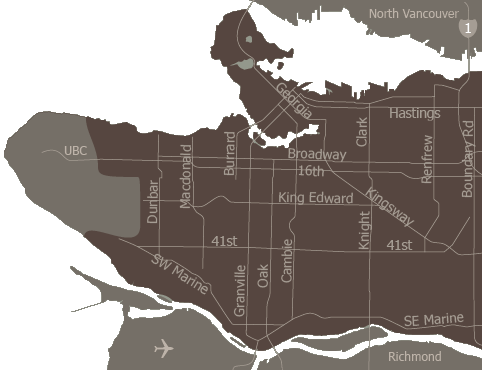
Every day, more than half a million people enter the Downtown core. The area - also known as the Central Business District - is a triangle of land nestled between Burrard Inlet and False Creek. The area - bordered by Stanley Park, the West End, and Cambie Street - is a patchwork of distinct communities, including Yaletown, Gastown, Coal Harbour, and the East False Creek.

Downtown is the city's and region's largest shopping district. Major department stores are located at its centre at the intersection of Georgia and Granville streets. At its eastern end, Gastown's night clubs, restaurants and specialty shops combine with the area's historic charm to make it a major tourist attraction. Similarly, Chinatown's ethnic character and specialty shops combine the area's unique heritage buildings to attract visitors and regional residents alike.

Did you know?

The Great Fire of 1886 reduced the vast majority of Vancouver's buildings to ashes. The catastrophe did little to stop development, however. As stumps smoldered, rebuilding began.

Cars in Vancouver drove on the left side of the street until January 1, 1922.

After the Wall Street Crash in 1929, Vancouver's warm climate and location at the western end of the transcontinental railway helped to make it the "Hobo Capital of Canada." The destitute set up shanty towns under the Georgia Viaduct and along the False Creek flats and on vacant land near the harbour on Burrard inlet.

The first traffic light was installed at the corner of Hastings and Main on October 18, 1928.

Parking meters were first installed in 1946. One hour of parking cost 5 cents.

A 1960s plan that would have seen historic Gastown buildings replaced by highrises, office towers, malls and freeways was scrapped in 1969. Between 1970 and 1975 the area's historic buildings and the neighbourhood were revitalized.

A tunnel connects the main post office on Georgia Street to the former CPR Station on Cordova Street. Now used by film crews in search of an eerie location, the 2,400-foot concrete passageway was originally used to move mail quickly to waiting waterfront trains.

Pioneer Cemetery lies along the shore at the eastern tip of Stanley Park between the Nine O'Clock Gun and the Brockton Point Lighthouse. When Stanley Park was officially opened in 1888 the city stopped using the site. Mountain View Cemetery on Fraser Street, purchased by the City in 1887, became the city's main burial ground.

When the CPR moved its construction camp headquarters from Yale to Vancouver, entire houses were placed on flatcars and transported to what became known as Yaletown.


Comments or questions? Send us e-mail at community@vancouver.ca

© 2005, City of Vancouver
Last modified: August 12, 2008