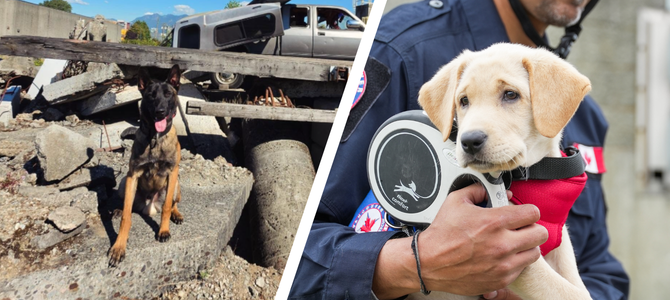
Rico sits on a rubble pile during a CAN-TF1 exercise and Indy takes a break from training
 Meet Rico and Indy, the newest rookie and recruit for the CAN-TF1 K9 team
When disasters strike, highly trained Urban Search and Rescue (USAR) teams are called upon to locate and rescue people in some of the most challenging environments imaginable. Among the specialists helping make that possible are the K9 (a play on "canine") search dogs of Canada Task Force 1 (CAN-TF1) in Vancouver, whose skills are tested and refined through year-round training.
Earlier this month, CAN-TF1, whose team members come from Vancouver Fire Rescue Services (VFRS), Vancouver Police Department (VPD), and other City departments and partners, hosted the annual K9 validations with teams from Alberta (CAN-TF2) and Manitoba (CAN-TF4), where these dogs undergo evaluations to participate in CAN-TF1. The event also highlighted two of the newest four-legged teammates at different stages of their careers – Rico and Indy.
At just 10 months old, Rico recently completed his Level 2 Live Find validation, a significant milestone on his journey as a disaster search dog. Working alongside his handler, Sgt. Bob Sandher of the VPD and K9 Team Lead, Rico demonstrated the ability to locate hidden targets in complex environments while navigating rubble and distractions. As part of the validation process, K9 candidates must successfully complete a series of tests assessing their searching abilities, obedience, directional control and agility.
Sgt. Sandher describes one quality as essential in a disaster search dog – drive. It's the relentless determination to keep searching through obstacles until the job is done, regardless of fatigue, environmental challenges or distractions.
To keep the dogs motivated during training, handlers use play-based rewards. "Some dogs are food-driven; the majority of our dogs are toy-driven,” says Sgt. Sandher. “They will go over obstacles, jump out of helicopters. Yesterday we were training on a hovercraft. They’re just happy to please, and they want to essentially win this toy.”
The newest puppy in the mix is Indy. Partnered with Captain Loughlan Rycroft of VFRS, Indy is just beginning the multi-year process of becoming a validated disaster search dog. The hope is that Indy will join the CAN-TF1 K9 team as one of the older members, Cooper, transitions into retirement at the end of next year.
“There is a mix of emotions,” shares Captain Rycroft. “I’m thrilled to finally meet Indy and start our journey together. While there are big shoes to fill with Cooper’s retirement approaching, I’m excited to learn and watch Indy grow into a full-fledged search dog with CAN-TF1.”
The relationship between K9 search dogs and their handlers is an important part of their success. From puppyhood to retirement, they spend countless hours training, bonding and responding as a team.
Dedicating this time to the K9 program isn't easy. For most handlers, this important work is in addition to their primary roles. Finding enough time and providing a variety of training can be challenging. They must remain deployment-ready and balance the needs of their day-to-day responsibilities. It requires an extraordinary level of dedication, commitment and sacrifice.
While the dogs often capture attention, the K9 program is built on collaboration among multiple agencies and specialists. These annual validation events bring together handlers, trainers and support personnel from across Western Canada to share expertise and maintain a high level of readiness.
Recent deployments for the team and the more experienced operational dogs have included landslides, floods, building collapses and wildfires in the Okanagan, helping support communities with response and recovery efforts.
As Rico reaches new milestones and Indy begins her training journey, both are helping ensure CAN-TF1 is ready when it's needed most. You can follow their journey, along with other CAN-TF1 K9s, on their Instagram page External website, opens in new tab.