 Artist's statement
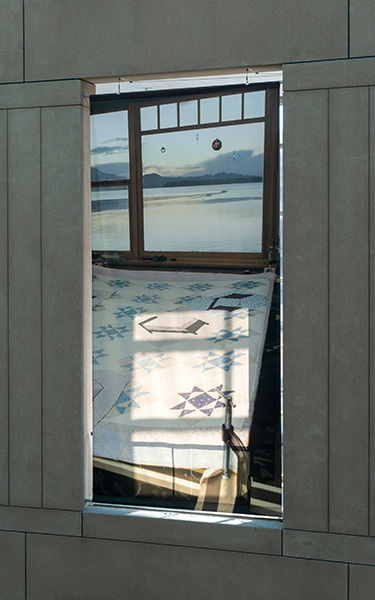
The banners and zine that make up the work Blanketing are reflections on an abundance of textile hand work.
In this project the term “blanketing” describes the active nature of making and using blankets. There is intention and creativity in both the creating and the long-term maintenance of blankets (quilts, comforters, duvets, throws, crib blankets, and more).
As objects with organic and inorganic components, blankets lead active lives, warming bodies and then carrying evidence of those lives in their:
- Shape
- Smells
- Stains
- Mends
- Eventually discarded fibers
The 6 banners show blankets that are part of the material and creative legacy of my mother, who passed last year, my late grandmothers, and other known and unknown textile workers, sewists, and makers. I have sewn some of them, but mostly they are gifted blankets that I have mended or transformed into clothing.
Every blanket shown in the banners includes the silhouette drawings of a bed with stacked blankets. These images are also on the cover of the zine Blanketing that accompanies the banners. It is available in the VPL Zine collection near the entrance to the library (level 2).
The ink print on fabric found in the photos is a legacy of a long-running social art project, Comforter Art Action, that I led from 2001 to 2018. I first designed and silk screened the images for an installation at The Glenbow Museum in 2009 (“Sew City”, Calgary, Alberta) and later gifted them to participants who helped to sew or knot blankets. Comforter Art Action produced and distributed over 100 tied patchwork blankets to shelters at the Mexican/US border, in Vancouver’s DTES, and at other international sites of refuge. The prints acknowledge the abundance of care and creativity in acts of making blankets. The zine series, Comforters, Comforters, Comforters (2003-07), documented the Comforter Art Action project and is still available in the VPL’s Zine collection.
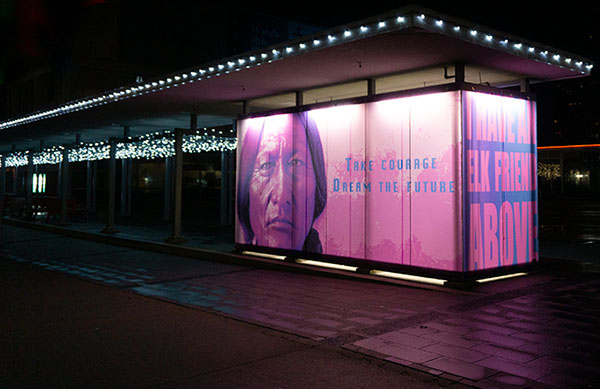
The 6 banner images show handmade and altered blankets in rural settings of the Pacific Northwest. They were photographed by Carl Wiebe and I on Malcolm Island where we were artists in residence at the Sointula House. Malcolm Island is in the traditional Kwakwaka'wakw territories of the 'Namgis, Mamalilikala, and Kwakuitl Nations. While in residence I visited a Regalia Making Workshop at U’mista Cultural Centre, 'Namgis First Nation, Alert Bay. Sointula, the name of the island’s small town and ferry terminus, is a Finnish word meaning “place of the chord” or “place of harmony”, all of which recalls the legacy of Finnish settlers including their local textile tradition of gill net rug making.
Additional credit – Carl Wiebe, photographer.
Nominator’s statement
I first met Lois Klassen when I was hired as a studio assistant for her publishing project Reading The Migration Library, a project committed to the publication of work about migration and displacement. Working with her, I became deeply inspired about the possibilities of small publishing and collaborative working models. She has always shared her skills, knowledge, and encouragement generously, invaluably contributing to my confidence and growth as an artist.
Across all mediums, Lois’s work is grounded in her commitment to her community. While working on RML, I was moved by the participation of not only artists and writers involved in the series, but many of Lois’s past collaborators, friends, and colleagues. Through her actions as artist and publisher, she has created a community of artists and writers who share commitment to collaboration and the open exchange of their work.
In Lois’s latest work Blanketing (from the series Practices of Everyday Ethics) she brings a focus to her textile practice with poignant meditations on:
- Grief
- Mutual aid
- Sustainability
- Ethical production
- The inherited legacy of women’s work
Lois expresses her gratitude for her ancestors and mentors, shedding light on her position in a muti-generational practice of artistry and community care. She caretakes the resulting heirlooms – both physical and incorporeal – preserving them for the future, mending where needed.
– Ruby Lewis

 Artist's statement